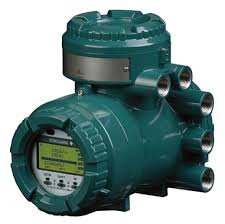
The product selection support tool “Product Finder” that operates on our website supports you. It is available to select more easily the most suitable products and specifications for the purpose and measurement conditions. Even with conventional models, we have provided stable flow measurement using our dual-frequency excitation method, our proprietary signal processing technology. Furthermore, ADMAG AXG can display and output the strength of flow noise separately from flow signal output. As a result, while realizing stable flow rate measurement, it is possible to grasp when flow noise is generated at “when,” “how long,” and “how much strength”, thus contributing to flow noise countermeasures. ADMAG AXG can display process values as trend graphs, as well as numerical information, and can “visualize” process value changes from the past to the present. This function displays one process value per screen, and it can switch up to four process values by switching the screen. There are 11 types of process values that can be displayed, and 6 types of screen update cycles. The vertical axis is scaled automatically and always displays a graph that is easy to see.
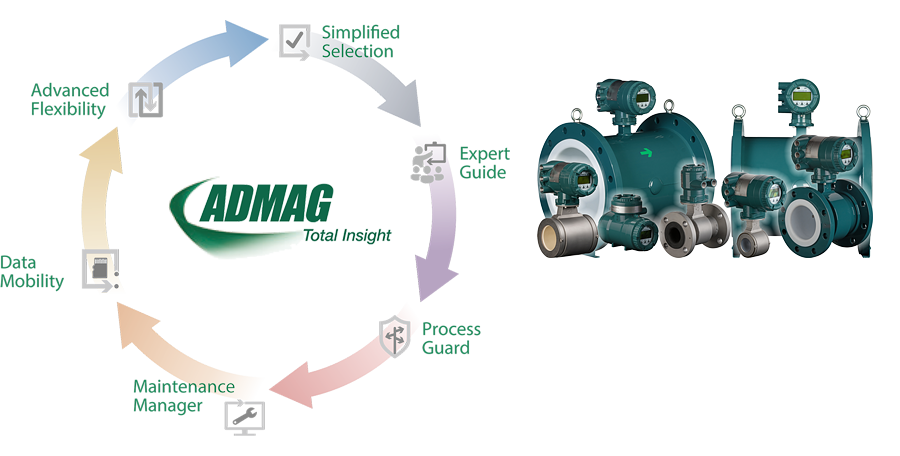
What Are Magnetic Flow Meters?
Magnetic flow meters, also known as magmeters, are widely used in a variety of industrial field applications due to their reliable flow rate measurements and features such as low-pressure loss and maintenance-free operation.
Yokogawa’s ADMAG series magnetic flow meters are designed with dual-frequency excitation to achieve stable measurement, zero stability, and quick response times.
ADMAG Total Insight Electromagnetic Flow Meters
Total Insight is a Yokogawa concept for optimizing operations and reducing maintenance costs through every phase of the product lifecycle. The ADMAG TI magnetic flow measurement series consists of the ADMAG AXG and the ADMAG AXW electromagnetic flow meters. For industries such as pulp & paper and more, ADMAG TI series magnetic flow meters have digesters that are reinforced and protections to resist wear and deformation and extend service life, even under harsh high-pressure and high-temperature conditions. The ADMAG AXG is a complete redesign of the ADMAG AXF and will accommodate bore diameters from 2.5 mm up to 500 mm, while the revamped ADMAG AXW will accommodate bore diameters ranging from 25 mm to 1800 mm.
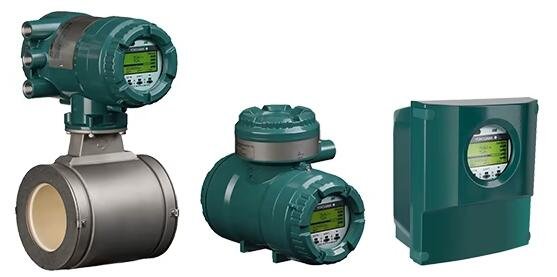
ADMAG AXG
The ADMAG TI series AXG is ideal for industrial applications including oil & gas, chemical, and pulp & paper. With built-in diagnostics and exclusive PFA injection liner, the AXG provides ease of operation while reducing total cost of ownership.
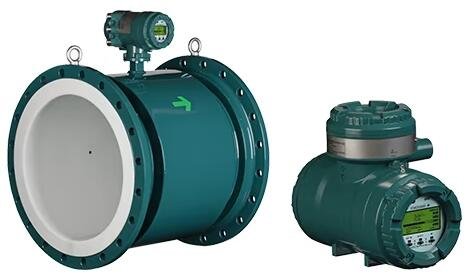
ADMAG AXW
The ADMAG TI series AXW is ideal for general industrial applications including water supply and sewage. Sizes range from 1″ to 72″ and an assortment of lining materials are available.
Magnetic Flowmeter CA Series
ADMAG AXR
Why Choose Us:
- You can get the perfect material according to your requirement at the least possible price.
- We also offer Reworks, FOB, CFR, CIF, and door to door delivery prices. We suggest you to do deal for shipping which will be quite economical.
- The materials we provide are completely verifiable, right from raw material test certificate to the final dimensional statement.(Reports will show on requirement)
- e guarantee to give a response within 24hours(usually in the same hour)
- You can get stock alternatives, mill deliveries with minimizing manufacturing time.
- We are fully dedicated to our customers. If it will not possible to meet your requirements after examining all options, we will not mislead you by making false promises which will create good customer relations.
Quality Assurance(including both Destructive and Non-Destructive)
- Visual Dimension Test
- Mechanical examining like tensile, Elongation and reduction of area.
- Impact analysis
- Chemical examination analysis
- Hardness test
- Pitting protection test
- Penetrant Test
- Intergranular Corrosion Testing
- Roughness Testing
- Metallography Experimental Test
Accuracy (Reading Value) Sensor Combination
AXG: ± 0.3 %
Size
AXG: 2.5 to 400 mm
Use Transmitter
General Purpose
Explosion Protection
Use Sensor Combination
General Purpose
Explosion Protection
Hygienic
Submersible
Explosion Protection Use
IECEx, ATEX, USA (FM), Canada (FMc), Japan, Korea, Brazil (INMETRO), EAC
Liner Material
Ceramics, PFA
Communication Protocols
HART 7, BRAIN
Current Signal
Input: 1 ch (Active)
Output: 2 ch (Active / Passive)
Pulse/Status Signal
Output: 2 ch (Active [With / Without Internal Resister] / Passive)
Status Signal
Input: 1 ch (Dry Contact)
Output: 1 ch (Passive)
Safety Integrity Level
SIL2
Others
LCD with improved environmental resistance
Equipped with temperature input terminal for Density correction and Calolie calculation
Features
⦁ Easy Setup Wizard, Trend Graph Display Function
⦁ Data Logging Function (with microSD card)
⦁ Parameter Backup / Restore / Duplication Function (with microSD card)
⦁ Zero Adjustment
⦁ Display Test Function
⦁ Input/Output Test Function
⦁ Electrode Adhesion Detection
⦁ Sensor Empty Check
⦁ Wiring Connection Diagnosis
⦁ Flow Noise Diagnosis
⦁ Low Conductivity Diagnosis
⦁ Electrode Insulation Deterioration Diagnosis