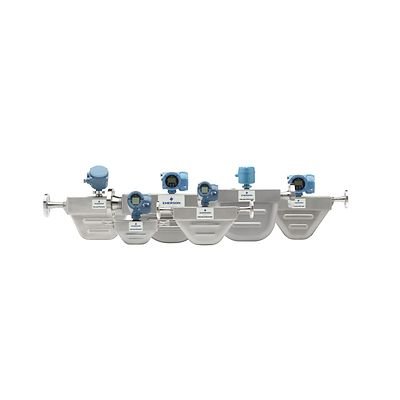
Coriolis Flow Meter Principles
The basic operation of Coriolis flow meters is based on the principles of motion mechanics. As fluid moves through a vibrating tube it is forced to accelerate as it moves toward the point of peak-amplitude vibration. Conversely, decelerating fluid moves away from the point of peak amplitude as it exits the tube. The result is a twisting reaction of the flow tube during flowing conditions as it traverses each vibration cycle.
Importance
A Coriolis meter is based on the principles of motion mechanics. When the process fluid enters the sensor, it is split. During operation, a drive coil stimulates the tubes to oscillate in opposition at the natural resonant frequency. As the tubes oscillate, the voltage generated from each pickoff creates a sine wave. This indicates the motion of one tube relative to the other. The time delay between the two sine waves is called Delta-T, which is directly proportional to the mass flow rate.
Range
Coriolis flow meters are extremely important in a multitude of flow-measurement applications. Offering a wide breadth of line sizes, flow measurement accuracy and turndown, these meters support many industries and can measure flow rates from a few grams/hour up to 120,000 lbs/minute. Coriolis meters have a wide, dynamic range due to the linear nature of the signal created while measuring flow.
Applications
Coriolis flow meters are used in a wide range of critical, challenging applications, in industries including oil and gas, water and wastewater, power, chemical, food and beverage, and life sciences.
Some common applications for Coriolis flow meters include:
• Applications with low to high flow rates
• Fiscal custody transfer
• Challenging liquid, gas and slurry applications
Liquid Accuracy / Repeatability
Up to ±0.4%of rate (±0.2%; of rate)
Gas Accuracy / Repeatability
Up to ±0.75%of rate (±0.5%of rate)
Density Accuracy / Repeatability
Up to ±0.003 g/cm3 (±0.0015 g/cm3)
Line Size
1/4″ (DN6) – 3″ (DN80)
Pressure Range
Up to 1450 psig (100 barg)
Temperature Range
-148 to 302°F (-100 to 150°C)
Electronics (soft)
Expansive I/O options including mA, Frequency, Discrete, HART, Modbus, Ethernet/IP, PROFINET, FOUNDATION Fieldbus
Turndown
10:1
Features
- Achieve high-performance basic liquid mass flow and volume flow measurement in a compact design
- Increase flexibility with available 316L stainless steel construction that is compatible with most fluids
- Cut costs with an integral transmitter that provides a flow-variable-only architecture
- Choose from rugged transmitter options including: Class I, Division 1/Zone 1 housing with optional local-operator interface
- Broad range of meter approvals and certifications, including; CSA (Class 1 Div 1 groups C and D, Class 1 Div 2 groups A, B, C and D), ATEX, IECEx, Ingress Protection 66/67, and NAMUR
- Minimize maintenance and boost long-term reliability with no moving parts to wear or replace
- Install virtually anywhere with compact design