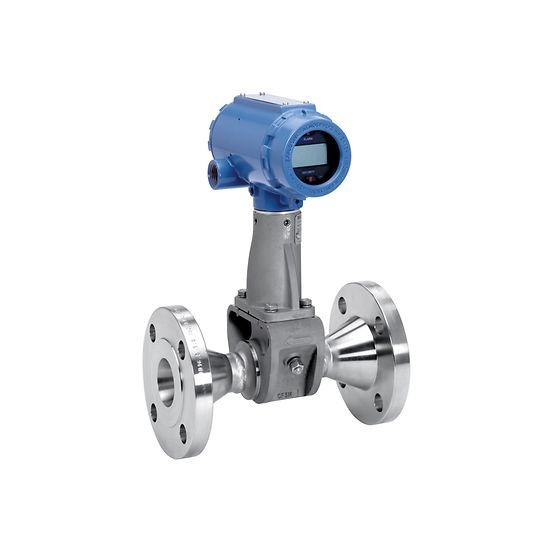
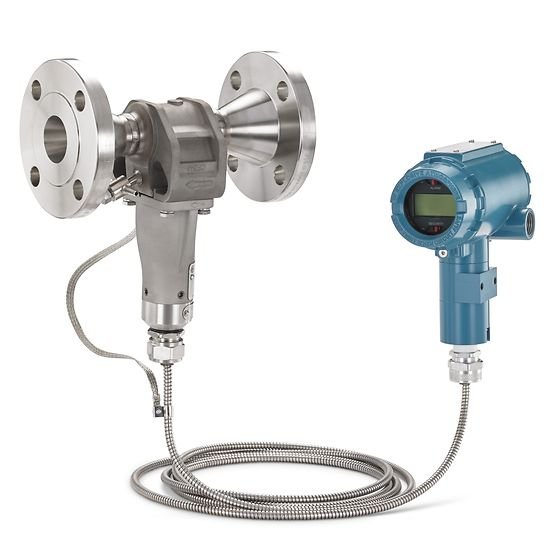
Advantages of Vortex Technology
Vortex flow meters offer many advantages for flow measurement including easy installation without impulse lines, no moving parts to maintain or repair, less leak potential and a wide flow turndown range. Vortex meters also offer very low power consumption, allowing for use in remote areas.
Additionally, Vortex meters are unique in that they can accommodate liquids, gasses, steam and corrosive applications. Vortex flow meters are also able to withstand high process pressures and temperatures.
How It Works
Von Kármán Effect
Vortex flow meters measure fluid velocity using a principle of operation referred to as the von Kármán effect, which states that when flow passes by a bluff body, a repeating pattern of swirling vortices is generated.
In a Vortex flow meter, an obstruction in the flow path, often referred to as a shedder bar, serves as the bluff body. The shedder bar causes process fluid to separate and form areas of alternating differential pressure known as vortices around the back side of the shedder bar.
Flow Measurement
The vortices cause a small sensing element either behind or within the shedder bar to oscillate back and forth at a specific frequency. The velocity of the working fluid is directly proportional to this frequency of the vortices generated by the shedder bar’s unique geometry. With the known cross sectional area of the pipe, volumetric flow can be calculated.
Often Vortex flow meters will also utilize a pressure and/or temperature sensor to achieve a compensated mass flow measurement.
Common Uses
Vortex flow meters are well suited for a variety of applications across a wide range of industries including oil and gas, refining, chemical and petrochemical, and food and beverage. Vortex flow meters also excel in steam-related applications including steam injection and steam measurement for district energy systems and industrial plants.
Safety
For safety-related measurement in SIS applications, dual and quad Vortex flow meters with redundant, independent sensors and electronics are critical for the prevention of common modes of failure and spurious shutdowns. The non-clog, leak-free Vortex flow meter design is ideal in hazardous chemical applications, especially where fugitive emissions are a concern.
Flow Meter Accuracy
± 0.70% of mass flow rate in water using 8800 MultiVariable (MTA/MCA option)
± 2% of mass flow in steam using 8800 MultiVariable (MTA/MCA option)
± 1.3% of rate at 30 psia through 2,000 psia in steam using 8800 MultiVariable (MPA option)
± 1.2% of rate at 150 psia in steam using 8800 MultiVariable (MCA option)
± 1.3% of rate at 300 psia in steam using 8800 MultiVariable (MCA option)
± 1.6% of rate at 800 psia in steam using 8800 MultiVariable (MCA option)
± 2.5% of rate at 2,000 psia in steam using 8800 MultiVariable (MCA option)
± 0.65% of volumetric rate for liquids (uncompensated)
± 1% of volumetric rate for gas and steam (uncompensated)
Turndown
38:1
Output
4-20 mA with HART® 5 or 7
4-20 mA with HART® 5 or 7 and scalable pulse output
FOUNDATION fieldbus ITK6 with 2 Analog Input blocks, 1 Backup Link Active Scheduler function block, 1 Integrator function block, and 1 PID function block
Modbus RS-485 with device status and 4 variables
Wetted Material
Stainless Steel; 316 / 316L and CF3M
Nickel Alloy; C-22 and CW2M
High Temp Carbon Steel; A105 and WCB
Low Temp Carbon Steel; LF2 and LCC
Duplex; UNS S32760 and 6A
Consult factory for other wetted material
Flange Options
ANSI Class 150 to 1500
DIN PN 10 to PN 160
JIS 10K to 40K
Flanges are available in a variety of facings
Consult factory for additional flange ratings
Operating Temperatures
-330°F to 800°F (-200°C to 427°C)
Line Size
1″ – 14″ (25 – 350 mm)
Features
- Improve low flow rate measurement performance with a smart reducer design
- Simplify installation and decrease costs and project risk with built-in reducers that eliminate field assembly
- Size the meter without changes to piping with the same face-to-face dimensions as the traditional 8800 meters
- An isolated sensor allows for online replacement without breaking the process seal
- Increase plant availability and eliminate potential leak points with a unique gasket-free meter body design
- The CriticalProcess valve (CPA option) provides an extra level of safety assurance by allowing users to verify secondary containment integrity
- Achieve vibration immunity with a mass balanced sensor and Adaptive Digital Signal Processing with visual filtering
- A standard internal signal generator included in every meter simplifies electronics verification
- Save time and money with no moving parts to repair or maintain